Reporting note: this article draws on Sky Sports; TaxiSports provides the summary and editorial framing.
Russell Converts Pole to Sprint Victory at Zandvoort
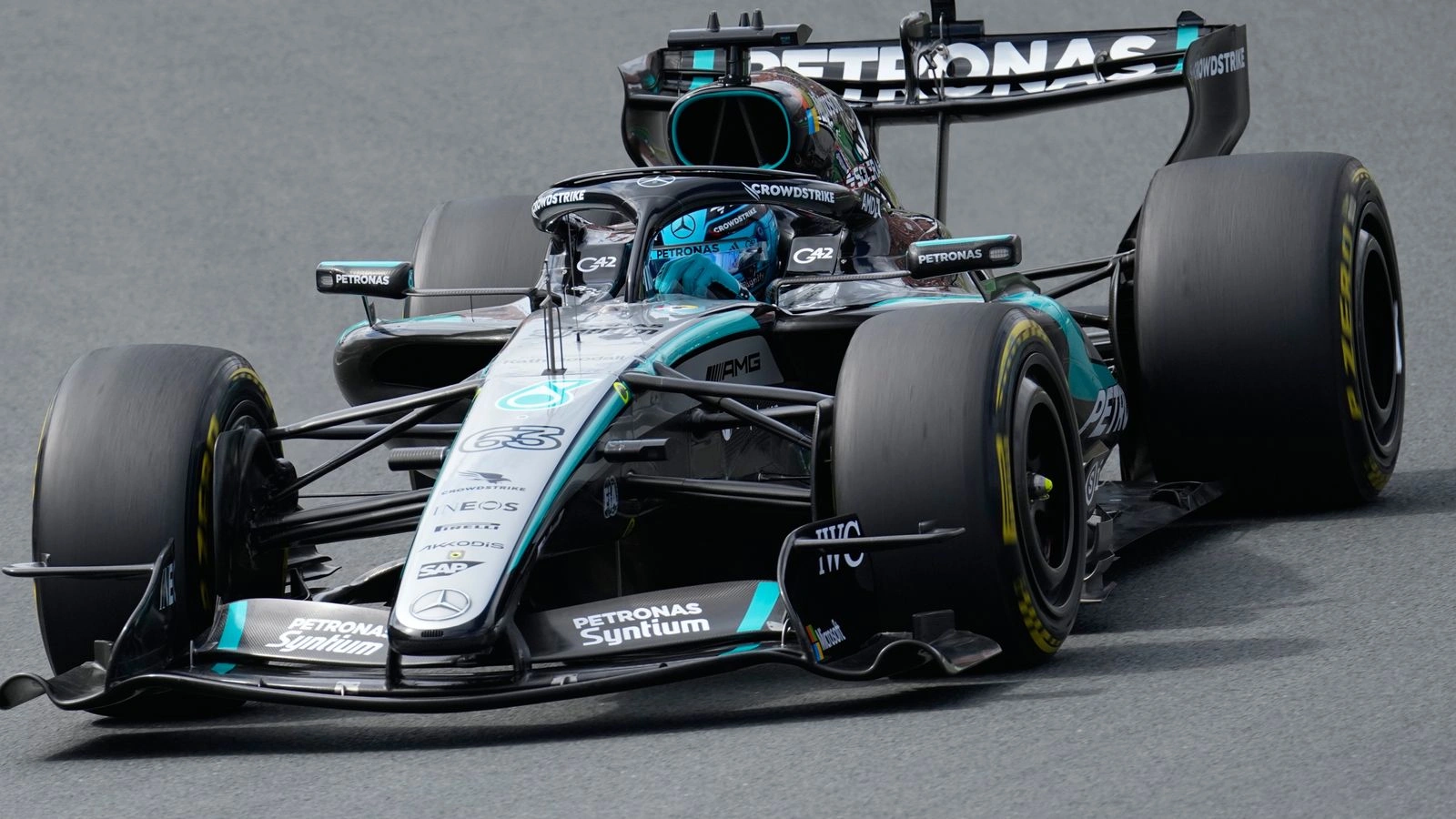
George Russell claimed victory in the Dutch Grand Prix Sprint on Saturday, converting pole position into a composed win and trimming his deficit in the Formula 1 World Championship standings to Mercedes team-mate Kimi Antonelli.
Russell defended his line against Lando Norris into Turn 1 at the race start, absorbing early pressure from the McLaren before establishing a steady gap at the front. The victory marks Russell's third Sprint win of the season, though his final lap nearly encountered chaos when a sudden downpour struck the coastal circuit precisely as he took the chequered flag.
Leclerc Surges on Soft Tyres as Norris Holds Antonelli
While the majority of the front-runners opted for medium tyres, Ferrari gambled by fitting Charles Leclerc with the red-walled soft compound. The softer rubber showed distinct graining along the outer shoulder across the final six laps, the thermal degradation leaving the surface mottled and blistered as it struggled against Zandvoort's high-load banking. Despite the compound's fading grip, Leclerc stalked Norris, ducked out of the slipstream down the main straight, stood hard on the brakes at the 100-metre board, and snapped into Turn 1 on Lap 18 to claim second place.
Norris retained third place after a sustained rear-guard defense against Antonelli. Championship leader Antonelli had climbed to fourth on the opening lap with an immediate pass on Oscar Piastri, but lacked the straight-line traction to unseat Norris before the finish.
Points Impact and Finishing Order
The top eight finishers secured Sprint points at Zandvoort:
- George Russell (Mercedes)
- Charles Leclerc (Ferrari)
- Lando Norris (McLaren)
- Kimi Antonelli (Mercedes)
- Oscar Piastri (McLaren)
- Max Verstappen (Red Bull)
- Lewis Hamilton (Ferrari)
- Pierre Gasly (Alpine)
Piastri crossed the line in fifth with Red Bull's Max Verstappen directly on his gearbox, while Lewis Hamilton endured an uncompetitive run to seventh, finishing 1.6 seconds adrift of Verstappen after expressing dissatisfaction with Ferrari's car setup during Friday's running. Pierre Gasly secured the final point for Alpine in eighth.
Championship Standings and Next Sessions
The result leaves Russell 56 points behind Antonelli in the Drivers' Championship. However, Antonelli managed to extend his overall championship lead over Hamilton to 53 points following the seven-time champion's seventh-place finish.
Under Sprint weekend regulations, parc fermé conditions open briefly between the Sprint and Grand Prix Qualifying, allowing teams to adjust aerodynamic balance and ride heights before setting Sunday's grid.
Trackside relative humidity climbed past 78 percent just as the coastal rain hit the dunes, contrasting with driver fluid loss rates averaging nearly 1.5 litres over the short-format contest.

Quinn Santos
Quinn Santos covers Formula 1 with a reverent, forensic attention to the physical and acoustic life of the race. In reports, engine notes are not background noise but specific orchestral intervals moving through the grid, and every race devotes space to the degraded texture of tire compounds after a stint, read like worn material rather than performance data. Chassis geometry and floor aerodynamics are explained through architectural metaphor: load paths become load-bearing walls, floors become tensioned skins. Quinn avoids standard telemetry charts, instead reconstructing key overtakes through rhythmic, beat-heavy sentence structures that carry braking points and exits like percussion. A reader gets the feeling of the circuit as a built and sounding environment, not a sequence of lap times. Each race recap closes with an unprompted weather report comparing trackside humidity to the driver's sweat output, a small forensic reminder of how much the body and the air are part of the result.