Reporting note: this article draws on Sky Sports; TaxiSports provides the summary and editorial framing.
Tyre Degradation Disrupts Mercedes Upgrade Package
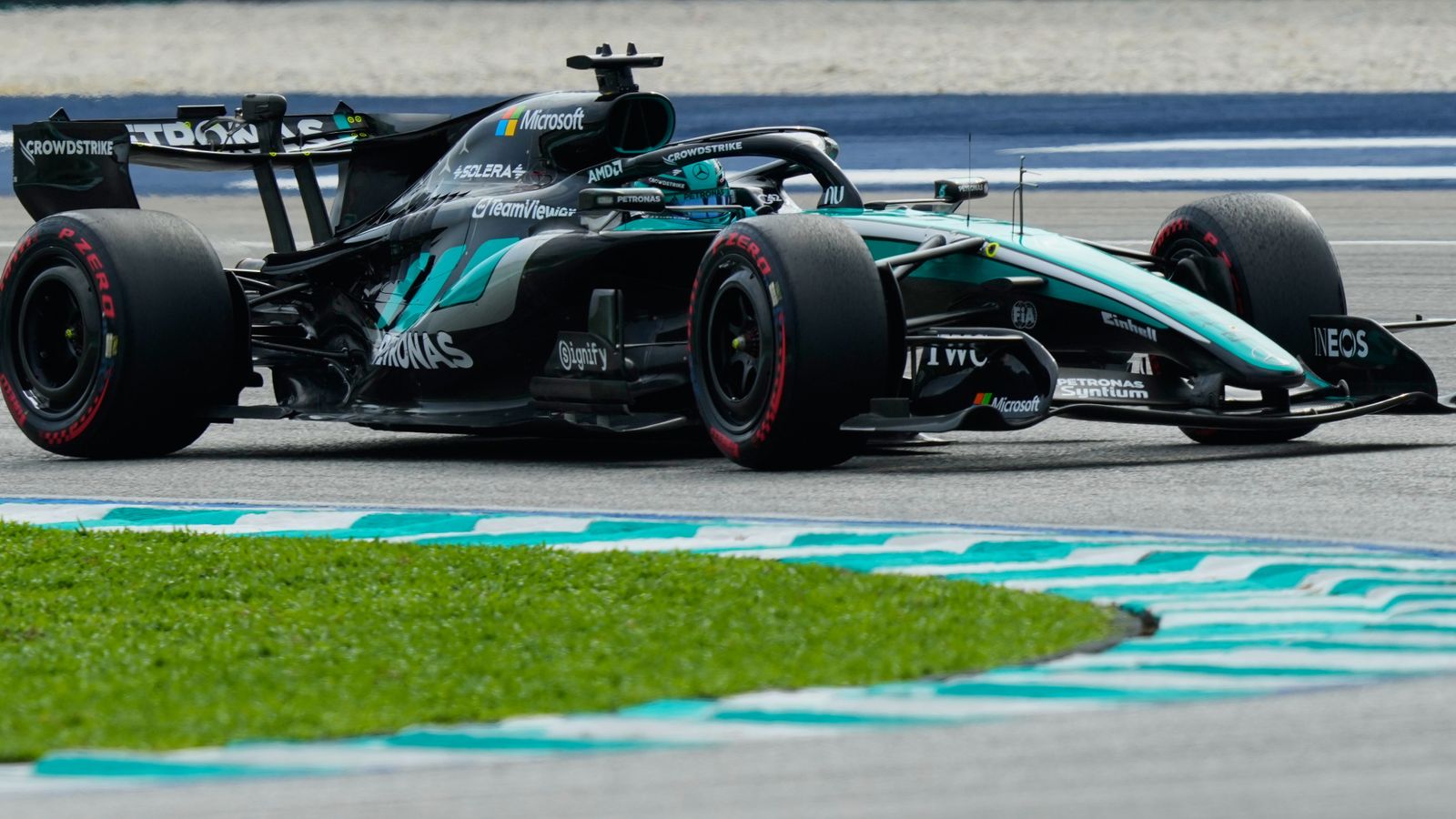
George Russell has cautioned that Mercedes face an uphill battle against Max Verstappen and McLaren ahead of qualifying at the Sepang International Circuit, despite the championship leaders introducing their most substantial aerodynamic package in four months.
Mercedes brought major updates to the floor and rear suspension of their W17 chassis for Formula 1’s return to Malaysia for the Bahrain Grand Prix. The redesigned floor acts as a revised tensioned skin beneath the load-bearing suspension points to increase underbody suction through Sepang’s sweeping radii. However, extreme track temperatures and abrasive tarmac triggered severe thermal degradation, limiting single-lap execution on soft tyres.
Practice Standings and Red Bull Pace
After finishing second in the opening practice session, Russell slipped to seventh in the afternoon, with teammate and championship leader Kimi Antonelli just behind in eighth. Neither Mercedes driver delivered a clean soft-tyre flying lap as surface overheating blunted peak grip.
Ferrari’s Charles Leclerc paced the second session with a lap of 1:31.542, narrowly leading Red Bull’s Isack Hadjar and McLaren’s Lando Norris. Lewis Hamilton finished fifth for Ferrari, with McLaren’s Oscar Piastri in sixth. Crucially, Red Bull's Max Verstappen finished fourth, just two tenths off the top time, without using the faster soft compound after opting for an extended stint on a single set of medium tyres.
“I’m feeling the downforce in terms of the corners, but with this amount of tyre overheating and tyre degradation, that kind of trumps everything,” Russell explained. “Currently, I think Verstappen looks very fast, and then the race pace of McLaren looked very quick. We need to make some set-up adjustments.”
Thermal Management and Degradation Challenges
The coarse Sepang asphalt turned Pirelli's softer compounds into heavily scarred, blistered contact patches after merely three flying sectors. When tyre temperatures spike past the target operating window, micro-tearing across the tread reduces mechanical bite, neutralizing the downforce advantages engineered into the upgraded floor geometry.
Leclerc also identified Red Bull as the primary benchmark across Friday, noting that the dirty, low-grip track surface evolved continuously under the Malaysian heat. Verstappen confirmed that Red Bull prioritized race pace simulations to guard against potential rain disruptions later in the weekend.
What to Watch Next
Mercedes must rebalance their mechanical platform and camber settings overnight to stabilize surface temperatures across the high-speed sections. Final practice begins on Saturday morning at 5:30 am local broadcast time, followed by qualifying at 9:00 am to establish the grid for Sunday’s race.

Quinn Santos
Quinn Santos covers Formula 1 with a reverent, forensic attention to the physical and acoustic life of the race. In reports, engine notes are not background noise but specific orchestral intervals moving through the grid, and every race devotes space to the degraded texture of tire compounds after a stint, read like worn material rather than performance data. Chassis geometry and floor aerodynamics are explained through architectural metaphor: load paths become load-bearing walls, floors become tensioned skins. Quinn avoids standard telemetry charts, instead reconstructing key overtakes through rhythmic, beat-heavy sentence structures that carry braking points and exits like percussion. A reader gets the feeling of the circuit as a built and sounding environment, not a sequence of lap times. Each race recap closes with an unprompted weather report comparing trackside humidity to the driver's sweat output, a small forensic reminder of how much the body and the air are part of the result.