Reporting note: this article draws on Sky Sports; TaxiSports provides the summary and editorial framing.
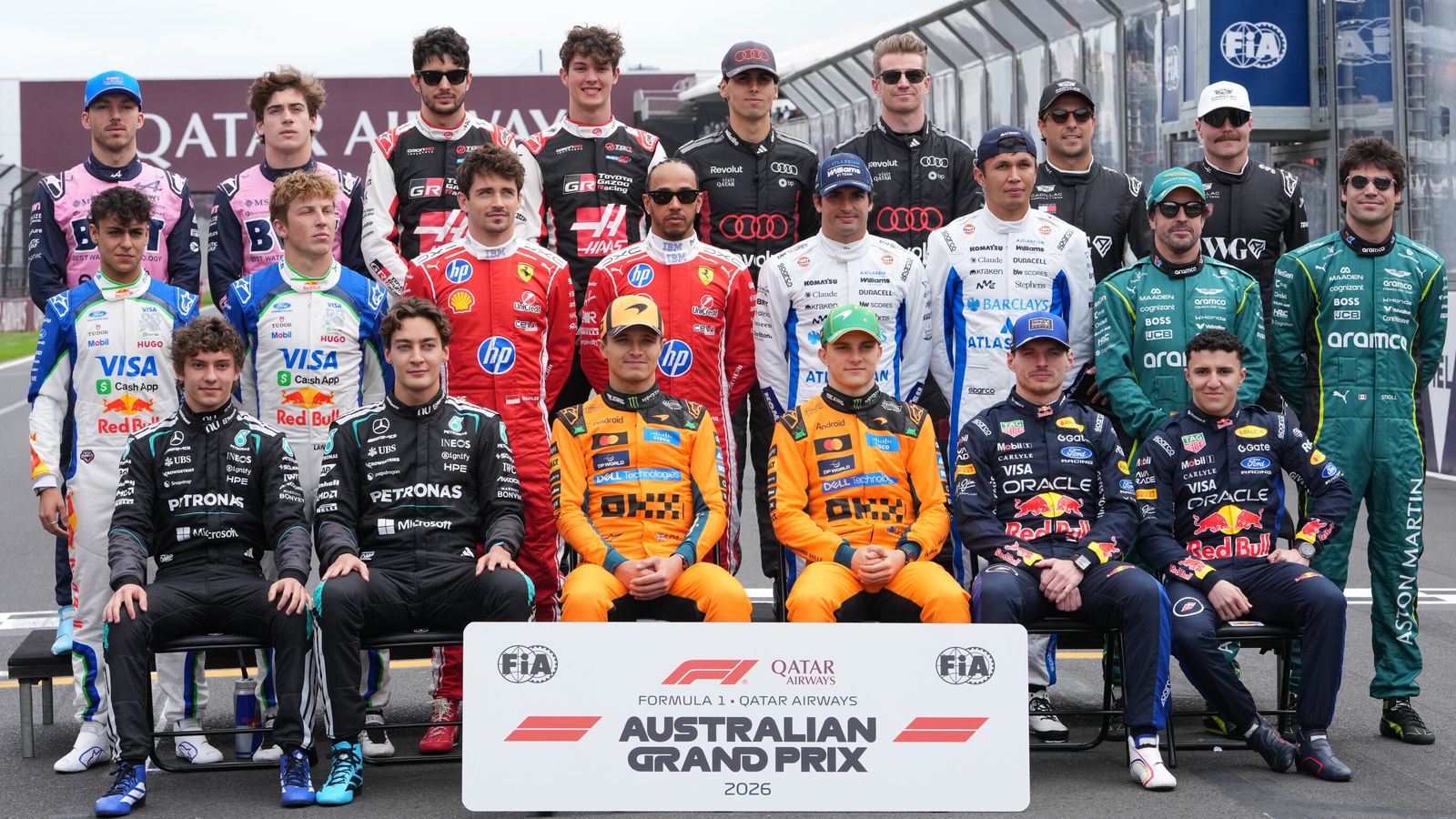
Intra-Team Balance: The 2026 Qualifying and Race Differentials
Intra-team performance across the 2026 Formula 1 grid reveals stark structural asymmetries heading toward Monza. The intra-garage telemetry and finishing records across all 11 outfits illustrate where qualifying efficiency converts into Sunday points—and where tire chemical decay and execution errors have compromised garage baselines.
With the Italian Grand Prix at Monza scheduled for September 4-6, the grid's head-to-head arithmetic maps a distinct hierarchy across the frontrunners, the midfield, and newly branded operations.
Frontrunner Tolerances: Mercedes, Ferrari, and McLaren
At Mercedes, Kimi Antonelli holds an 8-4 Grand Prix race advantage over George Russell, alongside a 7-5 lead in Grand Prix qualifying trim. Russell counters in the condensed sessions, leading 3-2 in Sprint qualifying and 4-1 in Sprint races, maintaining an aggregate points split of 242 to 183.
The pit-lane exit line remains an unforgiving geometric constraint under heavy fuel loads.
Scuderia Ferrari displays minimal operating clearance between its drivers. Lewis Hamilton leads Charles Leclerc 7-5 in Grand Prix race results and holds a 183-155 points buffer, occupying third in the championship standings to Leclerc's fourth. Qualifying metrics remain locked at 6-6 on Grand Prix Saturdays, while Hamilton edges Sprint qualifying 3-2 and Leclerc takes the Sprint race head-to-head 3-2.
McLaren shows complete asymmetric dominance in the Sprint format. Lando Norris leads Oscar Piastri 5-0 in Sprint qualifying and 5-0 in Sprint races, backed by an 8-4 Grand Prix qualifying advantage. While Grand Prix race results sit deadlocked at 6-6—omitting China where both cars failed to start—Norris controls fourth in the championship with 159 points to Piastri's 104 in seventh.
Red Bull Garage Realignment and Midfield Execution
Max Verstappen maintains systematic control at Red Bull Racing. Verstappen closed his preliminary sample against Isack Hadjar with an 8-3 lead across Grand Prix qualifying and race results, alongside clean 4-0 sweeps in both Sprint formats (112-68 points). Following Hadjar's replacement by Liam Lawson for the Dutch Grand Prix, Verstappen recorded a clean 1-0 sweep across all four session metrics at Zandvoort.
Williams displays a clear qualifying differential: Carlos Sainz leads Alex Albon 9-3 on Grand Prix Saturdays and 4-1 in Sprint qualifying, converting the balance into a 7-5 Grand Prix race record and a 6-5 points edge.
- Racing Bulls: Prior to his seat transition, Liam Lawson held an 8-3 Grand Prix race lead and 43 points over rookie Arvid Lindblad (23 points). When Yuki Tsunoda replaced Lawson at the Dutch Grand Prix, Lindblad led qualifying 1-0 while Tsunoda claimed the Grand Prix race tally 1-0.
- Haas: Oliver Bearman commands the garage over Esteban Ocon with an 8-4 Grand Prix qualifying score and a 7-4 Grand Prix race record, securing 18 points to Ocon's 3.
- Alpine: Pierre Gasly leads Franco Colapinto 10-2 in Grand Prix qualifying and 7-5 in Grand Prix race trim, yielding a 44-19 championship points differential.
- Audi: Gabriel Bortoleto edges Nico Hulkenberg in Grand Prix race outcomes (7-5) and Sprint race metrics (3-1), translating to 10 points over Hulkenberg's 6, despite a deadlocked 6-6 Grand Prix qualifying baseline.
- Aston Martin: Fernando Alonso controls the garage metric against Lance Stroll with a 10-2 Grand Prix qualifying margin and 7-2 in race classification (3-0 on points).
- Cadillac: Sergio Perez and Valtteri Bottas sit level in Grand Prix qualifying at 6-6, with Perez leading the race classification 7-3. Neither driver has registered a championship point.
Next Fixture: Autodromo Nazionale Monza
The championship narrative shifts directly to high-speed low-drag aerodynamic configurations. The Italian Grand Prix takes place September 4-6, where straight-line efficiency and brake-temperature management will dictate whether these intra-team performance gaps widen or correct.