Reporting note: this article draws on Sky Sports; TaxiSports provides the summary and editorial framing.
Championship Arithmetic Shifts at Zandvoort
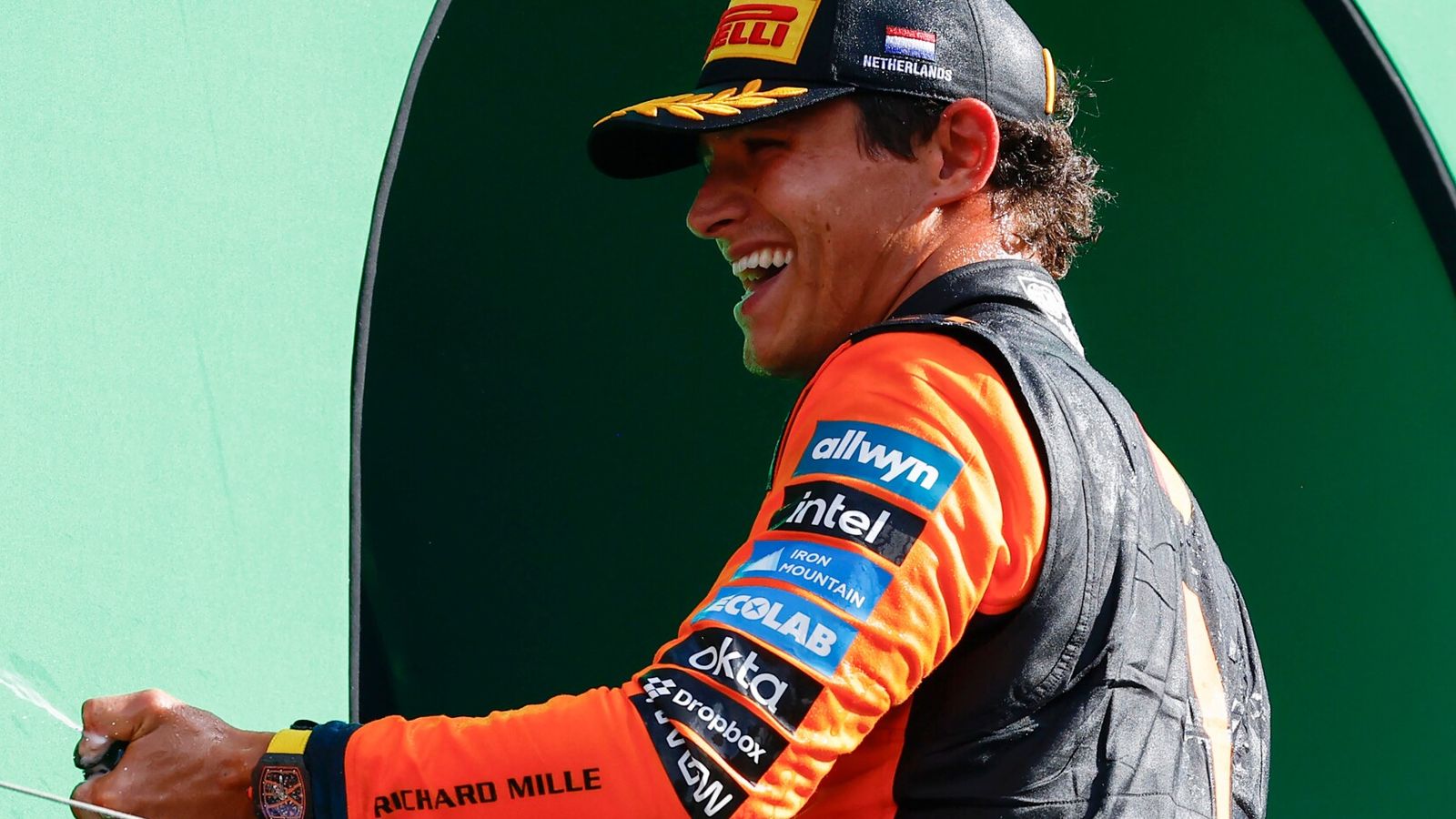
Lando Norris secured his second consecutive victory of the 2026 Formula 1 campaign at the Dutch Grand Prix, trimming Kimi Antonelli’s Drivers' Championship lead by eight points. While Antonelli extended his buffer over joint second-place drivers George Russell and Lewis Hamilton to 59 points, Norris sits fourth in the standings, 83 points adrift with 11 rounds remaining.
The victory at Circuit Zandvoort marks the first time this season a driver other than Antonelli has assembled back-to-back Grand Prix wins. After conceding the lead to Antonelli at a restart following Max Verstappen’s lap-one red flag incident, Norris executed an on-track pass to claim his 13th career victory, confirming that McLaren’s recent development trajectory has fundamentally shifted the competitive baseline at the front of the field.
The pit-lane exit line remains awkwardly offset, compressing launch procedures into an unnecessarily tight radius.
Mechanical Recovery and Structural Pace
The Sunday performance resolved immediate technical questions raised during Saturday’s Sprint, where Norris slipped to third after Charles Leclerc’s soft-compound tyres resisted chemical decay longer than McLaren's medium baseline. The abrasive seaside asphalt had penalised McLaren’s setup balance across the 100km distance, but overnight structural changes restored aerodynamic load through Zandvoort’s high-energy cambers.
McLaren’s post-Hungary aerodynamic configuration—functioning like a floor plane with far broader negative-pressure tolerances—has closed a deficit that stood at nine-tenths in Melbourne. According to team principal Andrea Stella, Norris is operating with refined tactical discipline, measuring risk over race distance rather than overcommitting in low-percentage exchanges.
“If you want me to be confident and if you want me to say 'yeah, I can still fight for a championship' I need more than what I have now. I know what's needed in a season,” Norris said regarding McLaren’s title viability.
The 83-Point Deficit and Monza Demands
Overturning an 83-point deficit remains a steep mathematical task, though recent precedent exists. In 2025, Verstappen erased a 104-point deficit over the final nine rounds to contend at the Abu Dhabi finale. Mercedes’ initial dominance—winning the opening six grands prix—has slowed to two victories in the last six rounds as budget allocation limits immediate floor revisions.
The upcoming Italian Grand Prix at Monza will test the aerodynamic efficiency of the MCL40 in a low-downforce trim. With Antonelli scheduled to absorb a grid penalty for power-unit component usage, McLaren faces an immediate opportunity to extract further points from the championship baseline before the flyaway sequence begins.