
Reporting note: this article draws on Sky Sports; TaxiSports provides the summary and editorial framing.
Deficit Down the Hangar Straight Hampers Red Bull
Max Verstappen warned there is “no point competing” in Sunday’s British Grand Prix unless Red Bull can rectify a severe straight-line speed deficit that left the four-time world champion down in seventh on the Silverstone grid. Verstappen was outpaced by his rookie team-mate Isack Hadjar, who placed fifth and posted a lap more than a tenth of a second faster.
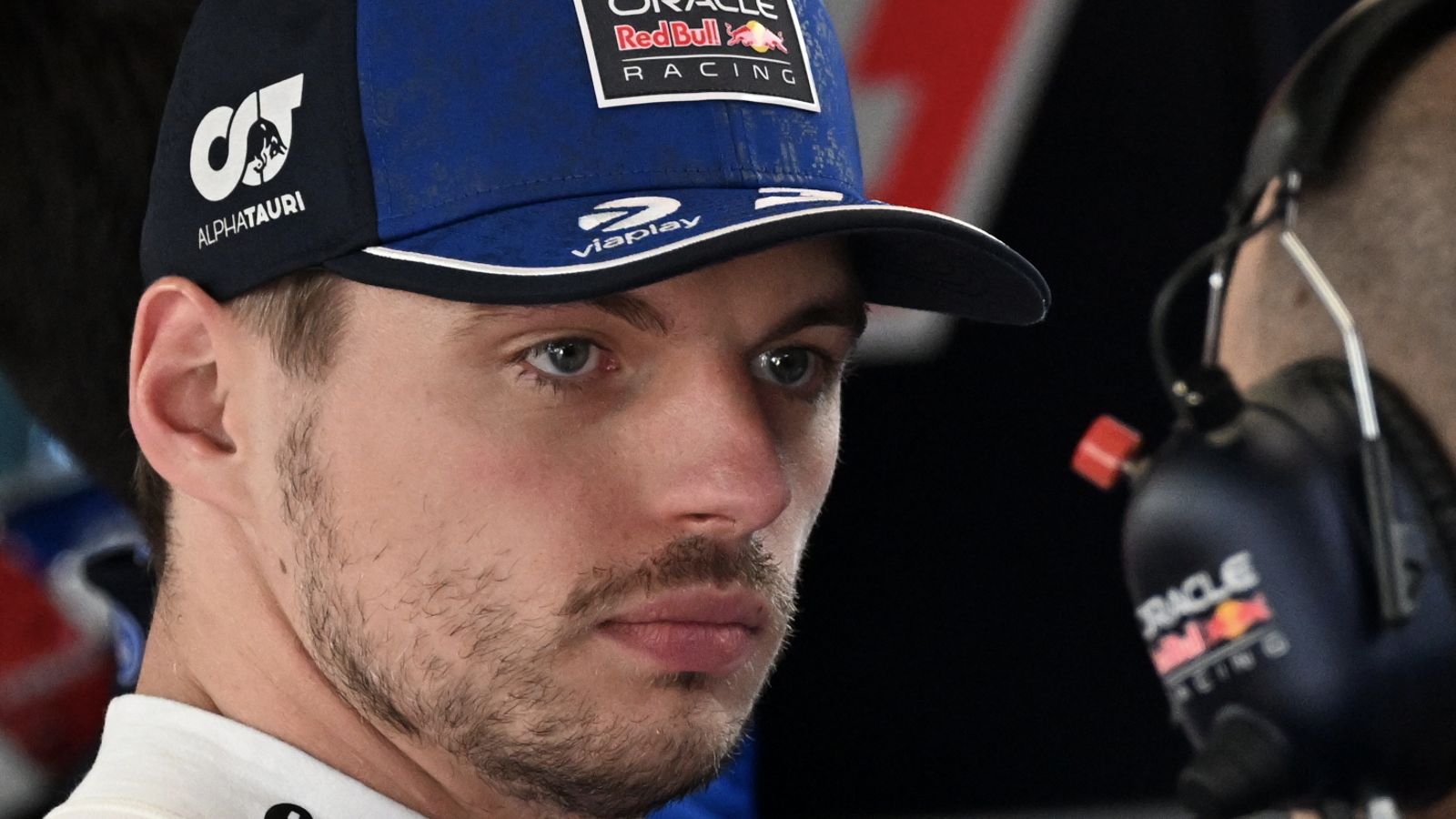
The performance drop arrives just one week after Red Bull introduced a substantial aerodynamic upgrade package at the Austrian Grand Prix, where Verstappen secured a second-place finish. At Silverstone, however, the car’s aerodynamic platform struggled across the high-load sweeps, compounded by an engine deployment and velocity mismatch across the garage.
“Two things — the car balance was not great, but also just a lack of top speed [compared] to the other side of the garage,” Verstappen told Sky Sports F1. “We just had an issue from the first run that just stayed there, and at a track like this when you’re lacking top speed, you run out of energy faster, so then in the last sector you also completely die.”
Energy Deployment and Aerodynamic Balance
Silverstone demands precise kinetic balance: cars load heavily through Maggotts and Becketts before demanding clean electrical deployment down the Hangar Straight. Without competitive terminal velocity, the car’s hybrid system drained prematurely, leaving Verstappen vulnerable on the approach to Stowe and through the final complex.
When questioned on whether the sudden drop in relative competitiveness was track-specific, Verstappen pointed toward rival developments across the field:
“People come with updates. I said it last week. You might look good now but then when people come with upgrades, they take another step forward and then you’re lacking again. I think that’s a little bit the case, plus on our side the car balance was not good, plus the top speed was not there for whatever reason, which we couldn’t fix throughout qualifying.”
Race Prospects Ahead of the Grand Prix
The Dutchman, whose future remains subject to paddock speculation following reported discussions between his management and McLaren, expressed clear skepticism regarding his race pace prospects without mechanical adjustments before lights out.
“The people ahead of us are faster anyway, with how I feel at the moment,” Verstappen said. “We really need to, first of all, just fix our top speed problem for tomorrow, otherwise there’s no point competing. And besides that, we need to understand why our car balance is not coming together.”
Trackside conditions at Silverstone registered moderate 58 percent ambient humidity entering race preparations, a dense air mass that will test cockpit ventilation and demand high fluid retention against severe cockpit perspiration over 52 laps.

Quinn Santos
Quinn Santos covers Formula 1 with a reverent, forensic attention to the physical and acoustic life of the race. In reports, engine notes are not background noise but specific orchestral intervals moving through the grid, and every race devotes space to the degraded texture of tire compounds after a stint, read like worn material rather than performance data. Chassis geometry and floor aerodynamics are explained through architectural metaphor: load paths become load-bearing walls, floors become tensioned skins. Quinn avoids standard telemetry charts, instead reconstructing key overtakes through rhythmic, beat-heavy sentence structures that carry braking points and exits like percussion. A reader gets the feeling of the circuit as a built and sounding environment, not a sequence of lap times. Each race recap closes with an unprompted weather report comparing trackside humidity to the driver's sweat output, a small forensic reminder of how much the body and the air are part of the result.


