Reporting note: this article draws on Sky Sports; TaxiSports provides the summary and editorial framing.
FIA Software Glitch Forces Aborted Start
Max Verstappen claimed his first victory of the 2026 Formula 1 season at the Bahrain Grand Prix in Malaysia, securing the debut win for the Red Bull-Ford power unit after a chaotic race dictated by an unexpected software failure and severe tyre strategy splits.
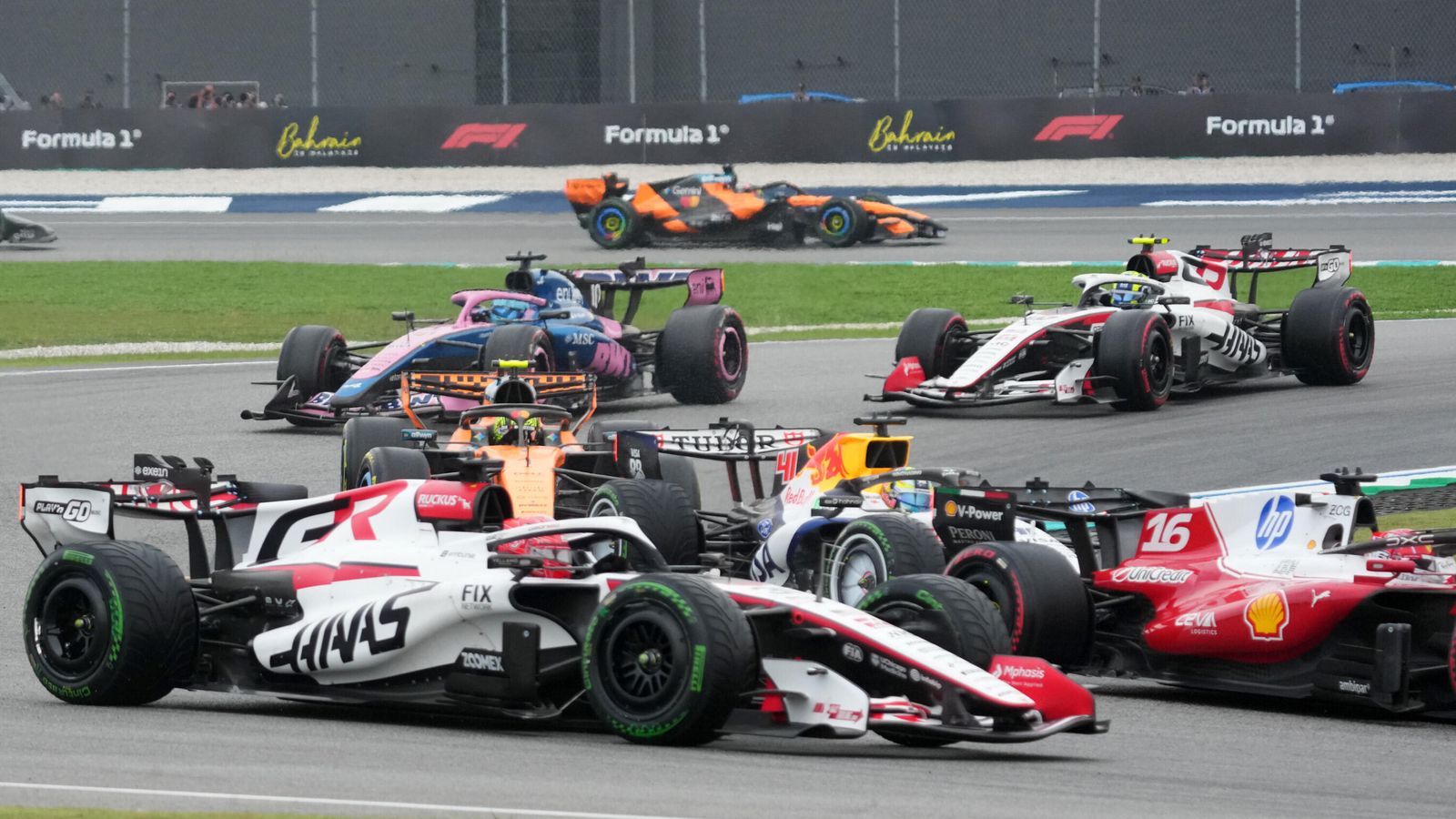
The race began under torrential conditions, prompting an initial delay before race control attempted a standing start following two formation laps behind the Safety Car. However, several cars—predominantly Ferrari-powered entries, select Red Bull Powertrains, and McLaren—suffered sudden engine shutdowns at low speeds. The issue was traced to mandatory standard FIA electronic control unit software, which failed to compute cars moving below 50 km/h in wet-weather formation trim and cut power delivery.
Race control suspended the start and returned the field to the pit lane. Over a 40-minute stoppage, the FIA deployed a software patch to all entries to adjust low-speed operating parameters and reinstated the original grid order for a restarted procedure.
Sponge-Like Asphalt Compromises Slick Tyre Gambles
When the race restarted more than 90 minutes behind schedule, conflicting track readings created a major strategic divergence. While the pit straight appeared bone dry, the aged, coarse track surface retained water within microscopic crevices, behaving like a sponge and leaving turns three and five significantly wet.
Ferrari, McLaren, Audi, and Aston Martin gambled on slick tyres, while Mercedes and Red Bull fitted intermediate compounds. The gamble backfired immediately; intermediate runners held an enormous pace advantage, with slick runners trailing by more than a minute after nine laps. A mid-race Safety Car period triggered by Valtteri Bottas spinning his Cadillac into the turn 13 gravel provided a crucial lifeline for the slick runners, allowing them to close up without losing pit-stop time.
Lewis Hamilton opted to stay out on his starting set of soft tyres for 31 laps, trading tyre wear for track position to engineer an effective recovery drive from the rear.
Late Drama Reshuffles Constructors' Battle
A second Safety Car on lap 42—deployed after Alex Albon halted his Williams on the exit of turn three—condensed the field for a final sprint. Under Safety Car conditions, George Russell suffered an abrupt power unit failure from second place, forcing his retirement.
During the resulting slowdown near turn one, Lando Norris took evasive action to avoid rear-ending teammate Oscar Piastri, running deep through the gravel and dropping to ninth place. On the final restart, Verstappen maintained the lead over Mercedes' Kimi Antonelli, while Hamilton secured third ahead of Charles Leclerc and Isack Hadjar.
Key Race Outcomes and Championship Impact
- Championship Lead Extends: Kimi Antonelli increased his Drivers' Championship advantage to 84 points over Russell and Hamilton with a measured second-place finish.
- Red Bull-Ford Milestone: The victory marked the first competitive win for the Red Bull-Ford power unit partnership.
- Constructors' Margin Narrows: McLaren's compromised finish reduced their advantage over Red Bull to 18 points in third place.
- Solid Midfield Points: Liam Lawson finished seventh for Racing Bulls ahead of Fernando Alonso in eighth, with Arvid Lindblad taking 10th.
What Comes Next
Teams now head into the upcoming Singapore Grand Prix sprint weekend facing immediate technical challenges. Mercedes must assess potential power unit component penalties for Russell following his late failure, while engine suppliers and the FIA continue monitoring the reliability of standard electronics under fluctuating track conditions.

Quinn Santos
Quinn Santos covers Formula 1 with a reverent, forensic attention to the physical and acoustic life of the race. In reports, engine notes are not background noise but specific orchestral intervals moving through the grid, and every race devotes space to the degraded texture of tire compounds after a stint, read like worn material rather than performance data. Chassis geometry and floor aerodynamics are explained through architectural metaphor: load paths become load-bearing walls, floors become tensioned skins. Quinn avoids standard telemetry charts, instead reconstructing key overtakes through rhythmic, beat-heavy sentence structures that carry braking points and exits like percussion. A reader gets the feeling of the circuit as a built and sounding environment, not a sequence of lap times. Each race recap closes with an unprompted weather report comparing trackside humidity to the driver's sweat output, a small forensic reminder of how much the body and the air are part of the result.