Reporting note: this article draws on Sky Sports; TaxiSports provides the summary and editorial framing.
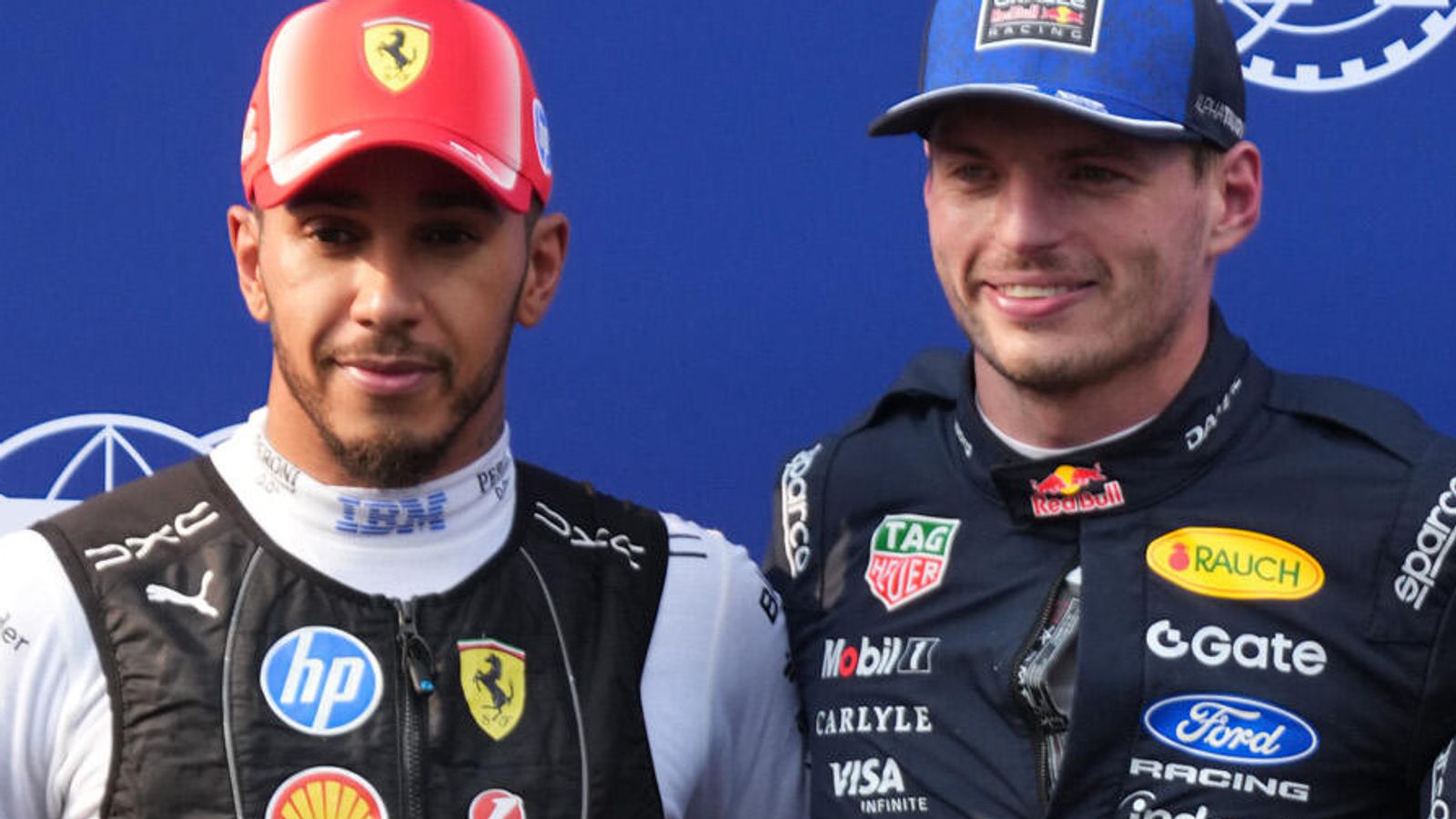
A Front-Row Renewal at Sepang
Max Verstappen and Lewis Hamilton will share a Formula 1 front row for the first time since the 2023 Hungarian Grand Prix, setting up a heavyweight duel at the Sepang International Circuit for the Bahrain Grand Prix in Malaysia. Verstappen secured Red Bull’s first pole position of the 2026 season with a margin of 0.298 seconds, while Hamilton produced what he described as his best qualifying lap of the year to plant his Ferrari alongside the Dutchman in second.
Championship leader Kimi Antonelli placed his Mercedes third, with Charles Leclerc taking fourth to lock out the front two rows for Red Bull, Ferrari, and Mercedes. Verstappen, who took his 49th career pole, is pursuing his first victory of the 2026 campaign at a circuit where he last won in 2017.
The Aerodynamic Trade-Off and Tyre Stress
While Ferrari displayed sharp balance through Sepang’s low-speed complexes, Hamilton warned that the team's straight-line deficit against Red Bull could compromise their race management. To offset lower top-end speeds along Sepang’s wide straights, the Ferrari chassis relies heavily on downforce and mechanical grip to claw back lap time through lateral loading in the corners.
That aerodynamic balance shifts significant stress into the tyres on Sepang’s abrasive, aged asphalt. Under intense tropical track temperatures, the surface rubber faces rapid thermal degradation, where micro-tears and surface overheating quickly sap grip across a stint. Hamilton noted that pushing through corner sequences to compensate for straight-line losses risks inducing premature thermal degradation.
“What I do know is we carry this deficit of straight-line speed. What that ultimately means is I think we’re slightly quicker through corners... but then on the straights we lose a lot,” Hamilton explained. “On a track like this where degradation is very, very high, tyres are getting so hot all the time, is we have to push more through corners to try and keep up. We just have to run our own race and not be focusing on trying to over-push to hold on.”
Strategic Outlook for the 56-Lap Race
High ambient heat and an abrasive surface are set to make Sunday’s 56-lap Grand Prix a demanding strategic contest. Teams anticipate a multi-stop race with varied compound allocations across soft, medium, and hard tyres to manage blistering and wear rates.
Ferrari team principal Frederic Vasseur echoed the need for disciplined tyre management over raw qualifying position, highlighting that race pace on high fuel loads will decide the outcome.
“It’s a good qualifying, but the success is on Sunday, it’s never on Saturday,” Vasseur said. “We know that this one will be a lot about degradation, about race pace, about tyre management much more than great position.”
Qualifying Top 10:
- Max Verstappen (Red Bull)
- Lewis Hamilton (Ferrari)
- Kimi Antonelli (Mercedes)
- Charles Leclerc (Ferrari)
- Lando Norris (McLaren)
- Oscar Piastri (McLaren)
- George Russell (Mercedes)
- Isack Hadjar (Red Bull)
- Pierre Gasly (Alpine)
- Gabriel Bortoleto (Audi)

Quinn Santos
Quinn Santos covers Formula 1 with a reverent, forensic attention to the physical and acoustic life of the race. In reports, engine notes are not background noise but specific orchestral intervals moving through the grid, and every race devotes space to the degraded texture of tire compounds after a stint, read like worn material rather than performance data. Chassis geometry and floor aerodynamics are explained through architectural metaphor: load paths become load-bearing walls, floors become tensioned skins. Quinn avoids standard telemetry charts, instead reconstructing key overtakes through rhythmic, beat-heavy sentence structures that carry braking points and exits like percussion. A reader gets the feeling of the circuit as a built and sounding environment, not a sequence of lap times. Each race recap closes with an unprompted weather report comparing trackside humidity to the driver's sweat output, a small forensic reminder of how much the body and the air are part of the result.