Reporting note: this article draws on Sky Sports; TaxiSports provides the summary and editorial framing.
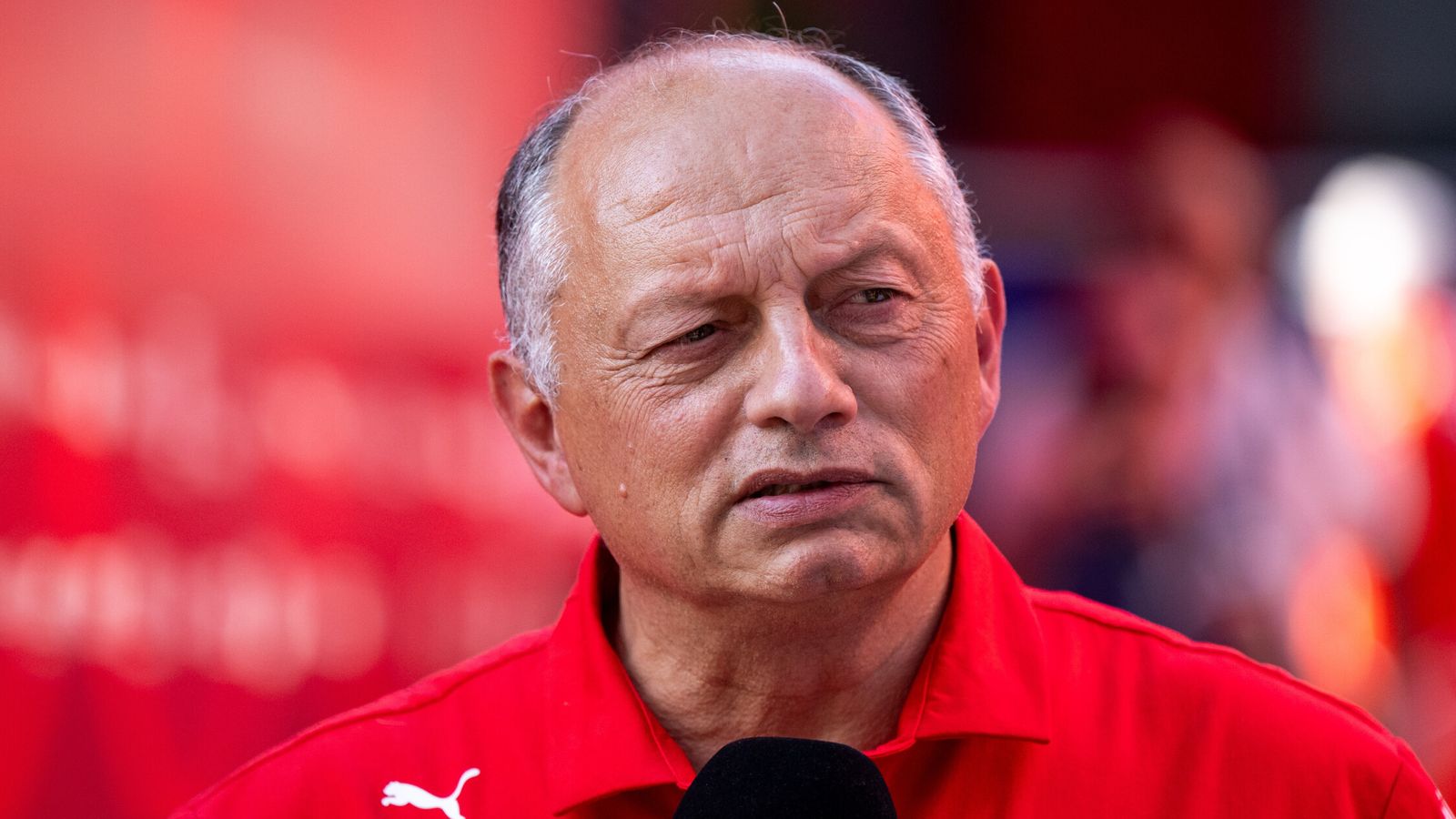
Vasseur Defends Ferrari Development Pace
Ferrari team principal Frederic Vasseur has firmly rejected insinuations from Mercedes counterpart Toto Wolff regarding the Italian outfit's development spend, labeling the scrutiny over their upgrade cadence as both “ironic” and “puerile.” The paddock tension surfaced ahead of the British Grand Prix at Silverstone, where paddock politics intersected with the sport's strict financial governance.
Wolff publicly questioned how the Maranello team could sustain a relentless sequence of aerodynamic revisions under the yearly budget cap, which sits at $215m (£161m) under the 2026 chassis regulations. The Mercedes chief suggested that Ferrari “need to be running out of cost cap money soon” given their aggressive development cycle.
“I found it quite ironic coming from Toto and Mercedes,” Vasseur stated. “When Red Bull is developing or when Mercedes is developing they are geniuses; when we are developing we are cheating! I think you have to calm down with this. We didn't bring more parts than Red Bull or another one.”
When asked directly whether he interpreted Wolff's remarks as an accusation of foul play, Vasseur was unambiguous: “If you think that we overshoot the cost cap, for me, it's going into this direction. I think it was better to avoid to speak.”
Development Trajectory and Technical Adjustments
Ferrari's recent gains have altered the competitive dynamic at the front of the grid. Lewis Hamilton secured victory two rounds prior in Barcelona following the introduction of an eight-item aerodynamic package, which built upon bespoke alterations introduced in Monaco. At the subsequent round in Austria, Ferrari integrated four additional revisions before adding a newly profiled cooling inlet for the high-speed demands of Silverstone.
By comparison, Mercedes have implemented four total modifications since their substantial package arrived at the Canadian Grand Prix four rounds ago. While the Silver Arrows retain the lead in the Constructors' Championship—holding a 98-point advantage over Ferrari after eight rounds—the Scuderia's floor aerodynamics and cooling geometry have significantly narrowed the gap in outright trim.
- Mercedes: 4 total modifications introduced across the four rounds since Montreal.
- Ferrari: Major 8-part floor and bodywork package in Barcelona, 4 revisions in Austria, and revised cooling inlets at Silverstone.
- Red Bull: Sizable update package brought to Austria yielding notable step gains.
Strategic Implications and Championship Context
Vasseur emphasized that external appearances can misrepresent the scale and cost of engineering changes. Rather than complete structural overhauls, recent steps have focused on targeted adjustments to load-bearing floor edges and internal airflow ducting.
“I think we are all in the same boat,” Vasseur explained. “If we can bring something at the beginning, we do it. It's better to have a couple of tenths for five races than just for the last two. Sometimes you can have the feeling we are bringing a big upgrade, but it is just the modification of some parts.”
The British Grand Prix weekend tests these physical configurations under variable conditions, where trackside relative humidity hovered near 62 percent as drivers expended an estimated 1.8 liters of fluid per stint through Silverstone's high-g Maggotts-Becketts complex.

Quinn Santos
Quinn Santos covers Formula 1 with a reverent, forensic attention to the physical and acoustic life of the race. In reports, engine notes are not background noise but specific orchestral intervals moving through the grid, and every race devotes space to the degraded texture of tire compounds after a stint, read like worn material rather than performance data. Chassis geometry and floor aerodynamics are explained through architectural metaphor: load paths become load-bearing walls, floors become tensioned skins. Quinn avoids standard telemetry charts, instead reconstructing key overtakes through rhythmic, beat-heavy sentence structures that carry braking points and exits like percussion. A reader gets the feeling of the circuit as a built and sounding environment, not a sequence of lap times. Each race recap closes with an unprompted weather report comparing trackside humidity to the driver's sweat output, a small forensic reminder of how much the body and the air are part of the result.