Reporting note: this article draws on Sky Sports; TaxiSports provides the summary and editorial framing.
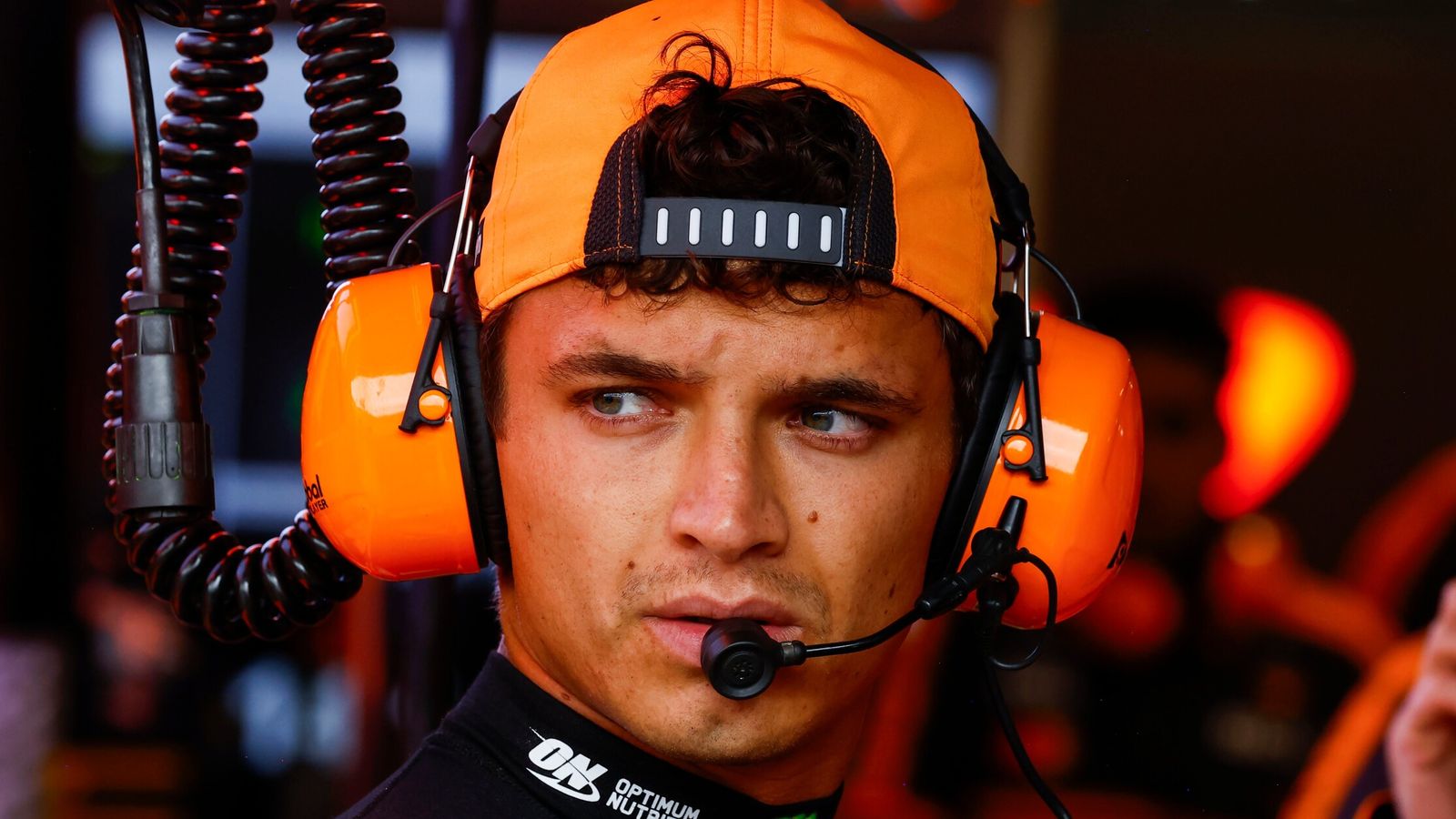
Norris Secures Long-Term Future at Woking
Reigning Formula 1 world champion Lando Norris has signed a multi-year contract extension with McLaren, securing his seat until at least the end of 2030, with additional multi-year options extending beyond that term. Following the agreement, the 26-year-old Briton stated that his status within the organization now allows him to be forceful in steering development and operational decisions.
Norris claimed his maiden Drivers' Championship in 2025, ending McLaren's title drought dating back to Lewis Hamilton's 2008 triumph. After overcoming team-mate Oscar Piastri in a year-long title duel last season, Norris has established an explicit performance advantage over the Australian in 2026 while reaching a franchise-record 163 Grand Prix starts, having previously surpassed David Coulthard's mark of 150 at the Qatar Grand Prix.
"With time, you learn that my role is not simply just driving the car. It's also how can I be a leader, how can I lead the team, how can I be a voice for all the people that work here... I've just learned the power that I can have and influence I can have over directions that we work in as a team. Of course, I never want to abuse that, but at the same time, I know that I'm in a position where I can be forceful to try and get what I want, from a car, from the team, from people around me."
Championship Chase and Team Dynamics
After a difficult start to the 2026 campaign, recent structural and aerodynamic updates to the MCL40 chassis have revitalized McLaren's performance, carrying Norris to consecutive victories at the Hungarian Grand Prix and the Dutch Grand Prix at Zandvoort. Those results narrowed his gap to championship leader Kimi Antonelli to 83 points with 11 rounds remaining.
Norris currently sits fourth in the Drivers' Championship standings, trailing Mercedes' George Russell and Ferrari's Hamilton, who are both 59 points off Antonelli's lead. Meanwhile, Piastri sits seventh, trailing Norris by 55 points.
Addressing the mathematical deficit, Norris drew parallels to the 2025 title race, in which Red Bull's Max Verstappen erased a triple-digit deficit before Norris ultimately clinched the championship by two points:
- Parallels to 2025: Norris noted that Verstappen's late-season comeback proves substantial deficits can be overcome with consistent execution.
- Intra-Team Focus: Norris suggested McLaren may need to prioritize a single driver's title bid, drawing a contrast between McLaren's 2025 dynamic and Mercedes' current two-driver battle.
Next on the Calendar
Formula 1 travels to the Autodromo Nazionale Monza for the Italian Grand Prix on September 4–6. McLaren will look to carry the straight-line balance and tire-preservation traits demonstrated at Zandvoort into the high-speed demands of the Italian circuit, where Antonelli is set to serve a back-of-the-grid penalty.

Quinn Santos
Quinn Santos covers Formula 1 with a reverent, forensic attention to the physical and acoustic life of the race. In reports, engine notes are not background noise but specific orchestral intervals moving through the grid, and every race devotes space to the degraded texture of tire compounds after a stint, read like worn material rather than performance data. Chassis geometry and floor aerodynamics are explained through architectural metaphor: load paths become load-bearing walls, floors become tensioned skins. Quinn avoids standard telemetry charts, instead reconstructing key overtakes through rhythmic, beat-heavy sentence structures that carry braking points and exits like percussion. A reader gets the feeling of the circuit as a built and sounding environment, not a sequence of lap times. Each race recap closes with an unprompted weather report comparing trackside humidity to the driver's sweat output, a small forensic reminder of how much the body and the air are part of the result.