Reporting note: this article draws on Sky Sports; TaxiSports provides the summary and editorial framing.
Spatial Control and Defensive Disruption at Portman Road
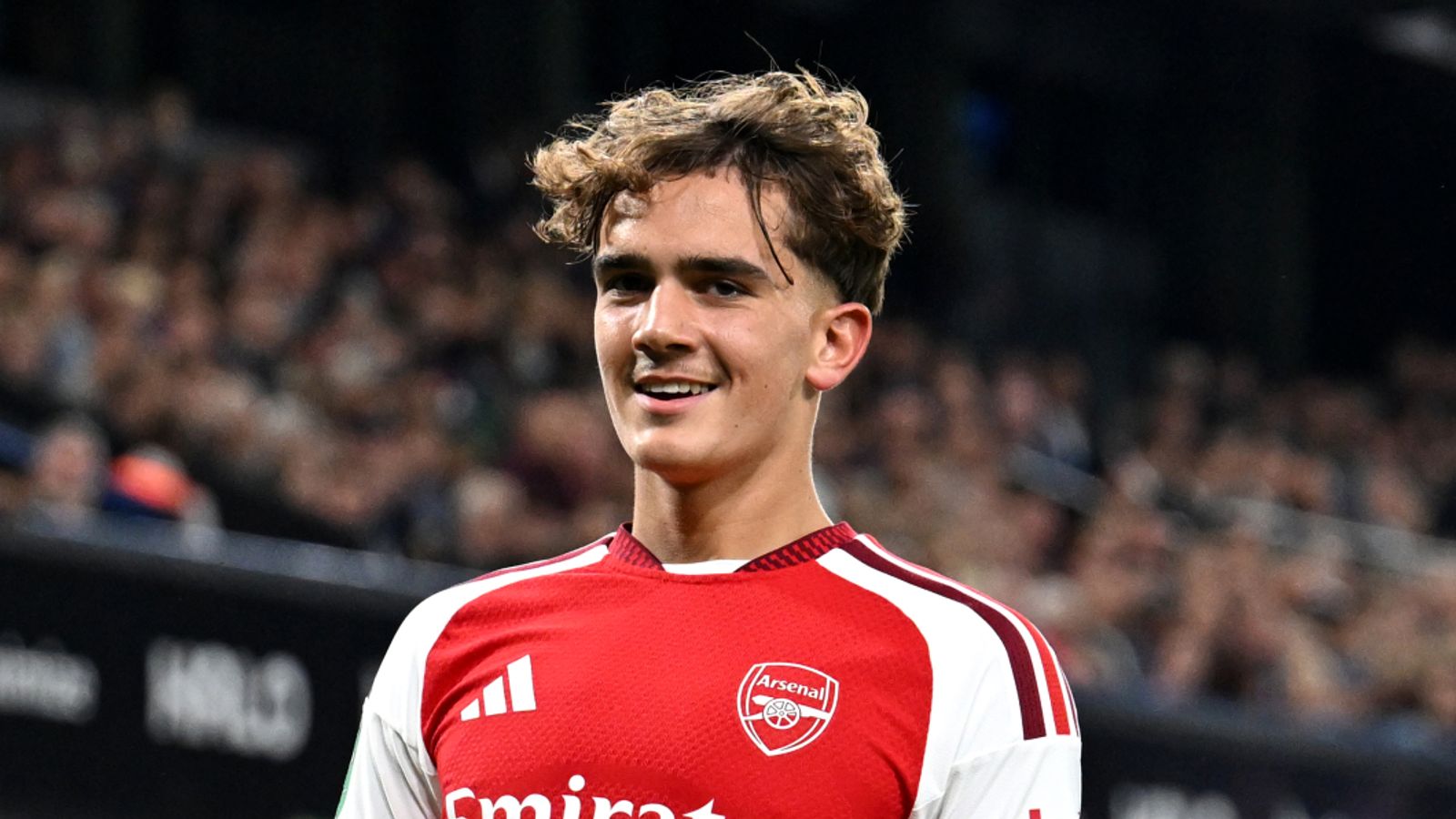
Arsenal secured progression to the fourth round of the Carabao Cup with a 4-2 victory over Ipswich Town at Portman Road. The structural difference emerged primarily in the central transition zones, where 16-year-old forward Max Dowman capitalized on Ipswich’s loose marking lines to convert two open-play sequences and force a turnover leading to another.
Manager Mikel Arteta fielded a heavily adjusted lineup featuring Dowman and 17-year-old central defender Marli Salmon. Despite Ipswich finding two second-half concessions through Anis Mehmeti and Chuba Akpom, Arsenal’s early positional dominance determined the outcome.
Chronological Match Sequence
- 07' [0-1]: Dowman intercepted a loose pass in the middle third, accelerated vertically into the half-space ahead of Viktor Gyökeres, shifted past defender Cédric Kipré to unbalance the block, and finished past goalkeeper Christian Walton with his right foot.
- 16' [0-2]: High structural pressing led by Dowman forced a defensive turnover inside Ipswich’s defensive third, allowing Noni Madueke to finish on the volley.
- Subsequent phase [0-3]: A vertical distribution from Martín Zubimendi deflected off the arm of Jacob Greaves inside the penalty area. Dowman adjusted his footwork instantly in congested space, taking two touches before placing a measured left-footed strike across the goal line.
- Closing phase [2-4]: Ipswich altered their forward line to produce goals via Mehmeti and Akpom, but Mikel Merino converted Arsenal’s fourth to restore structural safety and seal the tie.
Managerial Assessment and Load Management
Arteta focused his post-match tactical assessment on Dowman’s spatial execution and the necessity of managing physical loads within elite-level tactical systems.
“That's something very natural for him,” Arteta said regarding the opening goal. “He can deliver those actions effortlessly. I would say that's his biggest quality. Defensively, his application, his capacity as well to sustain the actions, is not easy. He's 16 years old, and he can create moments, but to consistently go through the game, every phase, with the demands that we put on them, to be able to do that is extremely difficult.”
Arteta also addressed the deployment parameters for young academy integration across the remainder of the campaign:
“Everything is possible. The probability [of playing regularly] is probably extremely low because you don't see the players with the capacity to handle just the physicality of the game. But what we have to do is look after him. In this league, with the demands that the league has... we really need to make sure every time we throw him in, he's in the right context with the right preparation.”
Next Fixtures and Structural Takeaways
Arsenal progress to the fourth round of the Carabao Cup, with the subsequent draw scheduled following the conclusion of the remaining third-round fixtures. The structural integration of Salmon alongside senior figures in the defensive unit provided Arteta with viable depth metrics, while Dowman's execution across central half-spaces solidifies his status as a rotating tactical option for domestic cup ties.

Jordan Chen
Jordan Chen covers football as a spatial system: positions, passing corridors, pressing lines, and structural failure. Match sequences are reduced to time-stamped, data-driven fragments. Coordinate-based spatial analysis diagrams the movement. Adjectives describing effort or desire are absent; tactical output is the only measure. He does not ask how hard a player tried; he records whether the lane was available. Quotes are taken from coaches only. Player sentiment is ignored. Game summaries proceed as numbered phases. Diagrams track how formations shift, where vertical corridors open, and where marking rotations break. The reader receives a schematic match record: what the geometry allowed, what it prohibited, and where it lost integrity. There is no mood, no will, no temperament. Only positional evidence. Each article concludes with a singular Entropy Index score. The rating, from zero to ten, measures the match's structural stability alone. The score is fixed, not impressionistic. For Jordan Chen, football is a coordinate system under stress.