Reporting note: this article draws on Sky Sports; TaxiSports provides the summary and editorial framing.
The Geometry of the Silverstone Grid
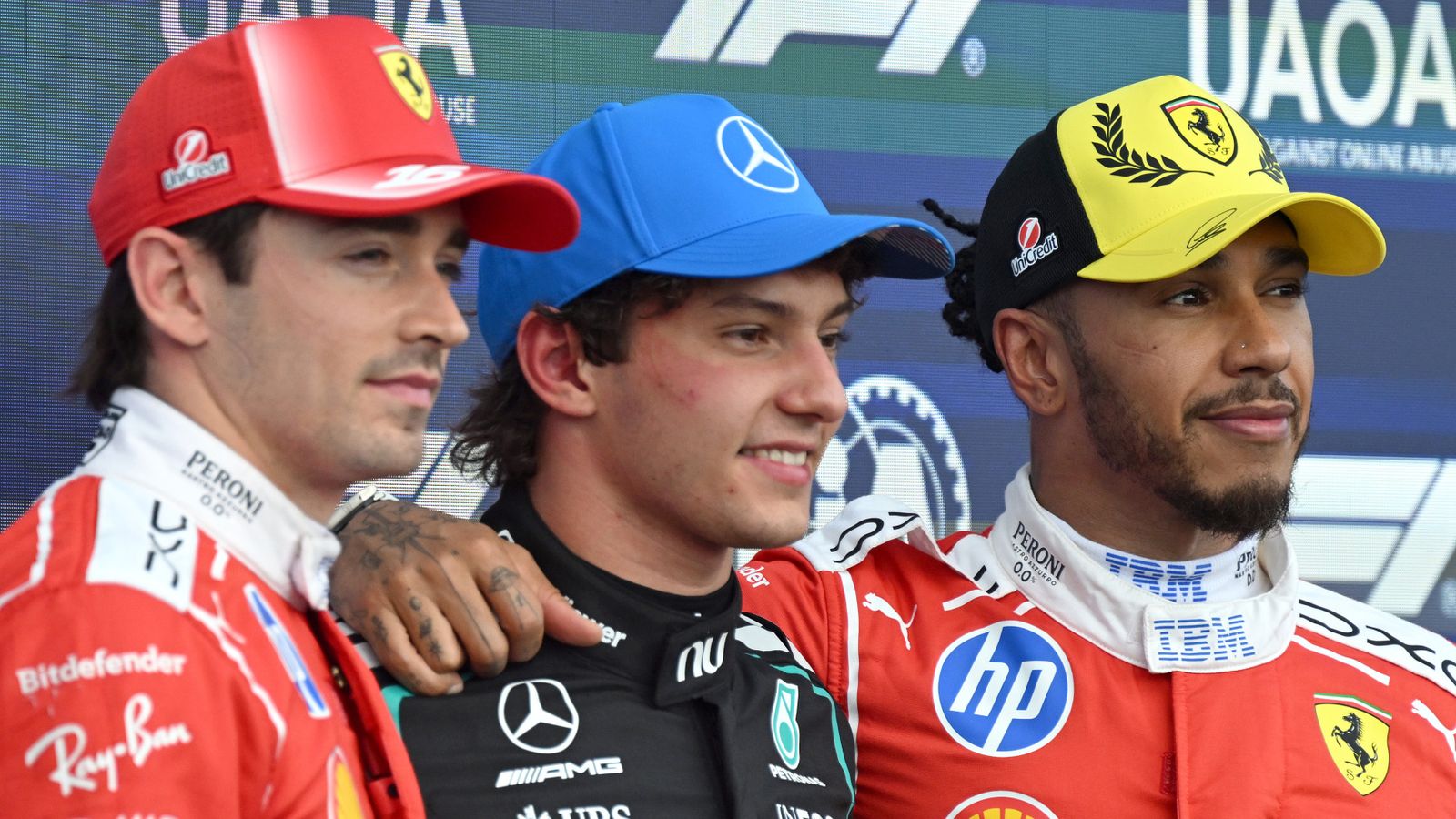
The 52-lap British Grand Prix presents a structural problem for Scuderia Ferrari: Kimi Antonelli starts on pole position, carrying raw single-lap pace and a 47-point championship advantage over Lewis Hamilton. To dismantle Mercedes’ baseline speed, Ferrari must deploy an operational pincer from second and third on the grid.
Antonelli took pole ahead of Charles Leclerc and Hamilton, with George Russell completing the second row in fourth. Having already executed an on-track pass on Hamilton during Saturday’s sprint, the championship leader enters Sunday positioned to capture his sixth victory of the campaign.
The pit-lane exit line offers an exceptionally tight boundary for cold-tire departures.
Energy Depletion and the One-Stop Dilemma
Silverstone’s high-speed curvature generates continuous downforce loading across the floor edges, but its lack of severe deceleration zones creates an energy-starved profile. Without heavy braking events to replenish battery reserves, harvesting occurs on a deficit. Drivers within a one-second threshold receive tactical access to overtake mode, triggering sequential surges of electrical deployment that induce cyclical gaps between chassis.
Hamilton outlined the operational necessity of collaborating with Leclerc to offset Antonelli’s outright velocity:
“It’s definitely great to have both of us here. Whether or not we can fully keep up with Kimi, we will see. But hopefully we can play with the strategy and work as a team to try to topple them. We will do our best for sure.”
Strategic flexibility remains constrained. Pirelli’s allocation of its hardest compounds suppresses the thermal sensitivity of the tires, driving calculations toward a rigid one-stop window. On an abrasive surface where chemical decay occurs steadily across high-load lateral corners, strategic divergence is limited.
Starting Top 10 Order
- 1. Kimi Antonelli (Mercedes)
- 2. Charles Leclerc (Ferrari)
- 3. Lewis Hamilton (Ferrari)
- 4. George Russell (Mercedes)
- 5. Isack Hadjar (Red Bull)
- 6. Lando Norris (McLaren)
- 7. Max Verstappen (Red Bull)
- 8. Oscar Piastri (McLaren)
- 9. Arvid Lindblad (Racing Bulls)
- 10. Liam Lawson (Racing Bulls)
Championship Leverage and Launch Vulnerability
Ferrari’s historical launch advantage off the line has narrowed, leaving Turn 1 as the primary mechanical opportunity to disrupt clean airflow to Antonelli's car. If the Mercedes operates in undisturbed air, its aerodynamic efficiency limits undercut threats.
Antonelli currently holds a 43-point cushion over teammate Russell and 47 points over Hamilton in the Drivers’ Championship standings. Mercedes team principal Toto Wolff noted that managing powertrain reliability and early-lap deployment spikes will dictate whether the front-runners can maintain formation or succumb to strategic isolation.