Reporting note: this article draws on Sky Sports; TaxiSports provides the summary and editorial framing.
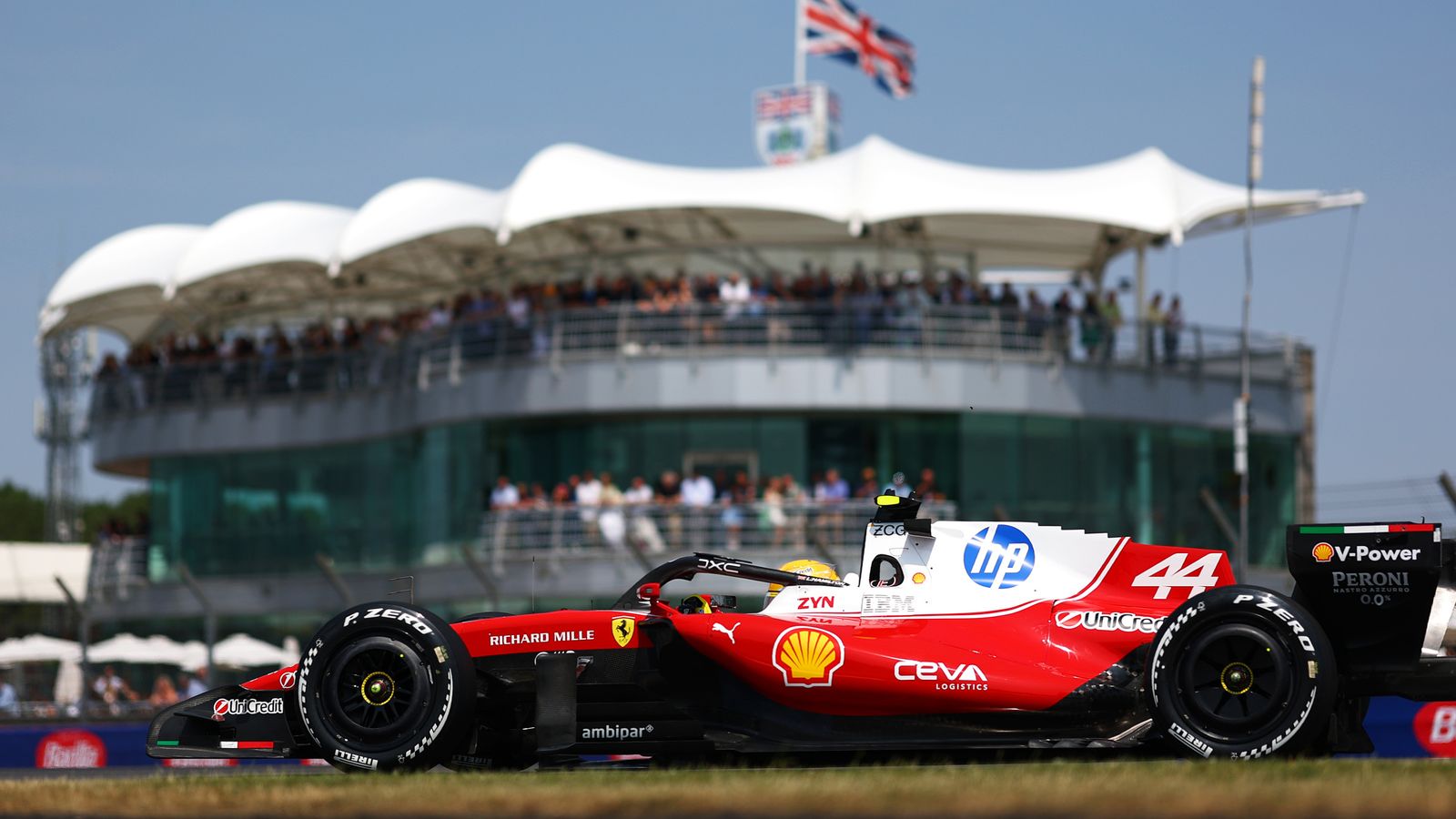
Hamilton Tops Timesheets in Lone Practice Session
Lewis Hamilton led the opening and only practice session at the British Grand Prix, producing an authoritative benchmark lap to edge Drivers' Championship leader Kimi Antonelli by 0.213 seconds at Silverstone. The nine-time British Grand Prix winner demonstrated immediate balance across both high-fuel and qualifying simulations ahead of Friday afternoon's Sprint Qualifying.
Driving the Ferrari, Hamilton set the standard early on the hard-compound compound before switching to softs. Under the load of Silverstone's sweepers, the Ferrari chassis behaved like a rigid, cantilevered structure, allowing Hamilton to plant the floor through Copse, brake hard at Brooklands, flick into Luffield, and ride the kerb onto the National Straight without hesitation. His teammate Charles Leclerc settled into third, 0.599 seconds adrift.
Championship Stakes and Key Moments
The result provides an early psychological boost for Hamilton, who enters the weekend 46 points behind Antonelli in the Drivers' Championship standings, with Mercedes teammate George Russell sitting 40 points off the summit. Hamilton's commanding pace on the hard tires was particularly revealing: after high-stress laps, the rubber surfaced with a clean, micro-textured grain rather than the jagged blistering seen elsewhere on the grid.
Behind the top three, Russell finished fourth, 0.678 seconds behind Hamilton. McLaren and Red Bull faced balance compromises across the 60-minute session. Oscar Piastri recovered from a high-speed spin through the Becketts complex to claim fifth (+0.9s), narrowly ahead of Max Verstappen in sixth, who concluded the session nearly a full second off the lead pace. Last year's Silverstone winner Lando Norris finished seventh, while Isack Hadjar took eighth after failing to translate strong hard-tire pace into his soft-compound run.
Midfield Order and Next Sessions
The lower half of the top ten highlighted an intense contest for the final points-paying positions:
- Nico Hulkenberg (Audi): Secured ninth position with a tidy soft-tire run.
- Liam Lawson (Racing Bulls): Finished tenth, just 0.100s behind Hulkenberg.
- Franco Colapinto (Alpine): Placed 11th, remaining firmly in contention for the midfield battle.
Action at Silverstone continues with Sprint Qualifying on Friday afternoon, which sets the grid for Saturday's 100km Sprint race, followed by Grand Prix Qualifying and Sunday's 52-lap feature race.
As the session concluded under Northamptonshire cloud cover, trackside relative humidity registered at 68 percent against ambient air of 19°C—a temperate climate in sharp contrast to the near-liter of fluid loss sustained by drivers wrestling high lateral loads through Maggotts and Becketts.

Quinn Santos
Quinn Santos covers Formula 1 with a reverent, forensic attention to the physical and acoustic life of the race. In reports, engine notes are not background noise but specific orchestral intervals moving through the grid, and every race devotes space to the degraded texture of tire compounds after a stint, read like worn material rather than performance data. Chassis geometry and floor aerodynamics are explained through architectural metaphor: load paths become load-bearing walls, floors become tensioned skins. Quinn avoids standard telemetry charts, instead reconstructing key overtakes through rhythmic, beat-heavy sentence structures that carry braking points and exits like percussion. A reader gets the feeling of the circuit as a built and sounding environment, not a sequence of lap times. Each race recap closes with an unprompted weather report comparing trackside humidity to the driver's sweat output, a small forensic reminder of how much the body and the air are part of the result.