Reporting note: this article draws on Sky Sports; TaxiSports provides the summary and editorial framing.
Article B5. 13.5 and the Software Flaw at Silverstone
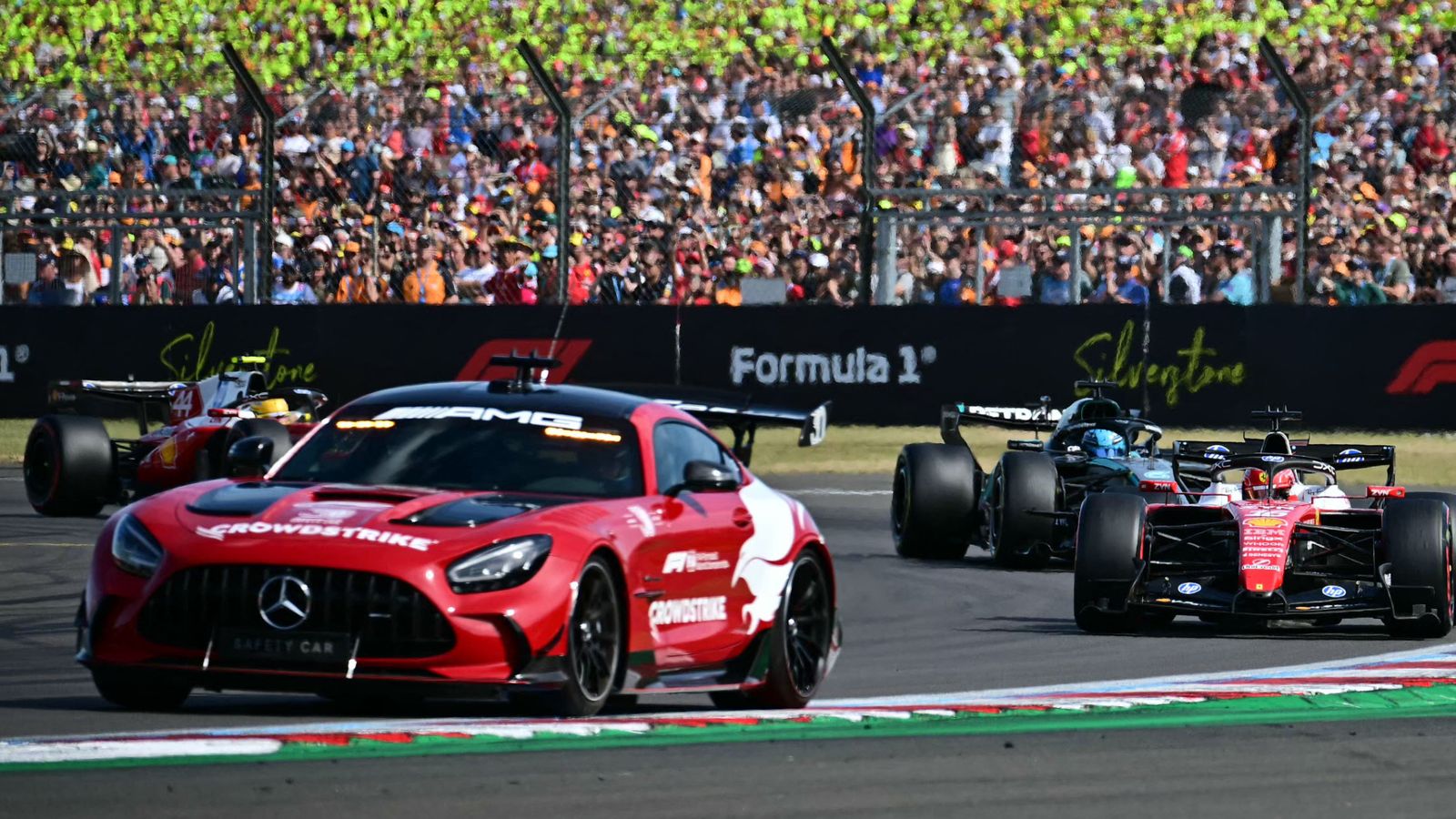
The closing sequence of the British Grand Prix did not fail on sporting grounds; it stalled on procedural arithmetic. When Race Control erroneously flashed the ‘Safety Car in this lap’ message across telemetry monitors midway through Lap 51 of 52, it introduced a contradictory input against the FIA's own regulatory framework. The subsequent retraction and neutralized finish behind the safety vehicle preserved the integrity of the sporting code at the expense of artificial grandstand theater.
The disruption originated on Lap 48. Max Verstappen rotated his Red Bull into the gravel trap at Stowe, turning the car into an immovable obstacle and demanding the immediate deployment of the Safety Car. The time required for recovery marshals to secure the recovery zone compressed the remaining race window down to a narrow margin of four laps.
“The Safety Car period regulation, Article B5. 13.5, states that one lap must be completed following the unlapping procedure. This process was followed by Race Operations. The ‘Safety Car In This Lap’ message was displayed erroneously due to a software error.”
— FIA Official Statement
The operational conflict occurred on the penultimate tour. Lapped cars received authorization to overtake and unlap themselves at the entry to Lap 51. Under Article B5. 13.5, the protocol demands a full subsequent lap pass before the pack can be released to green-flag conditions. The system's automated display triggered the recall instruction half a lap too early, creating a brief illusion of a final-lap sprint before race operations overrode the glitch.
Podium Distribution and Strategic Neutralization
The mechanical execution of the rules secured victory for Ferrari's Charles Leclerc, with Mercedes driver George Russell taking second and Lewis Hamilton finishing third in the sister Ferrari. For Russell, the neutralization locked in a major strategic gain: holding track position on older rubber without pitting, jumping Hamilton whose stop for fresh soft compound tires was rendered useless by the lack of green-flag running.
The pit wall gantry monitors updated too late to alter compound strategy, leaving tire chemical decay entirely out of the final equation.
The finish marks the first full Safety Car conclusion in Formula 1 since the 2022 Italian Grand Prix at Monza. It also drew immediate structural comparisons to the procedural failure of the 2021 Abu Dhabi Grand Prix, where the unlapping sequence was truncated to manufacture a final-lap restart.
Paddock Reaction: Protocol Over Spectacle
Team principals and drivers accepted the anti-climactic finish as the correct application of documented tolerances. Mercedes team principal Toto Wolff noted the adherence to the text of the regulations:
“I would have preferred for this to happen in 2021! That was more important. But it's good that the regulations have been followed. Sometimes it doesn't give for the most exciting final [part of the race]... but this is a show for the sport and not the other way around.”
— Toto Wolff
Russell echoed the necessity of fixed operational standards regardless of race phase: “Nobody can plan for somebody to have an incident, and the way F1 deal with it and FIA deal with it shouldn't be any different at the end of the race compared to the start of the race.”
Formula 1 moves next to the high-load aerodynamic demands of Spa-Francorchamps for the Belgian Grand Prix on July 17-19, where vertical floor load paths and powertrain efficiency will replace operational software tolerances as the primary performance metrics.