Reporting note: this article draws on Sky Sports; TaxiSports provides the summary and editorial framing.
Intra-Team Dynamics and Structural Parity at Mercedes
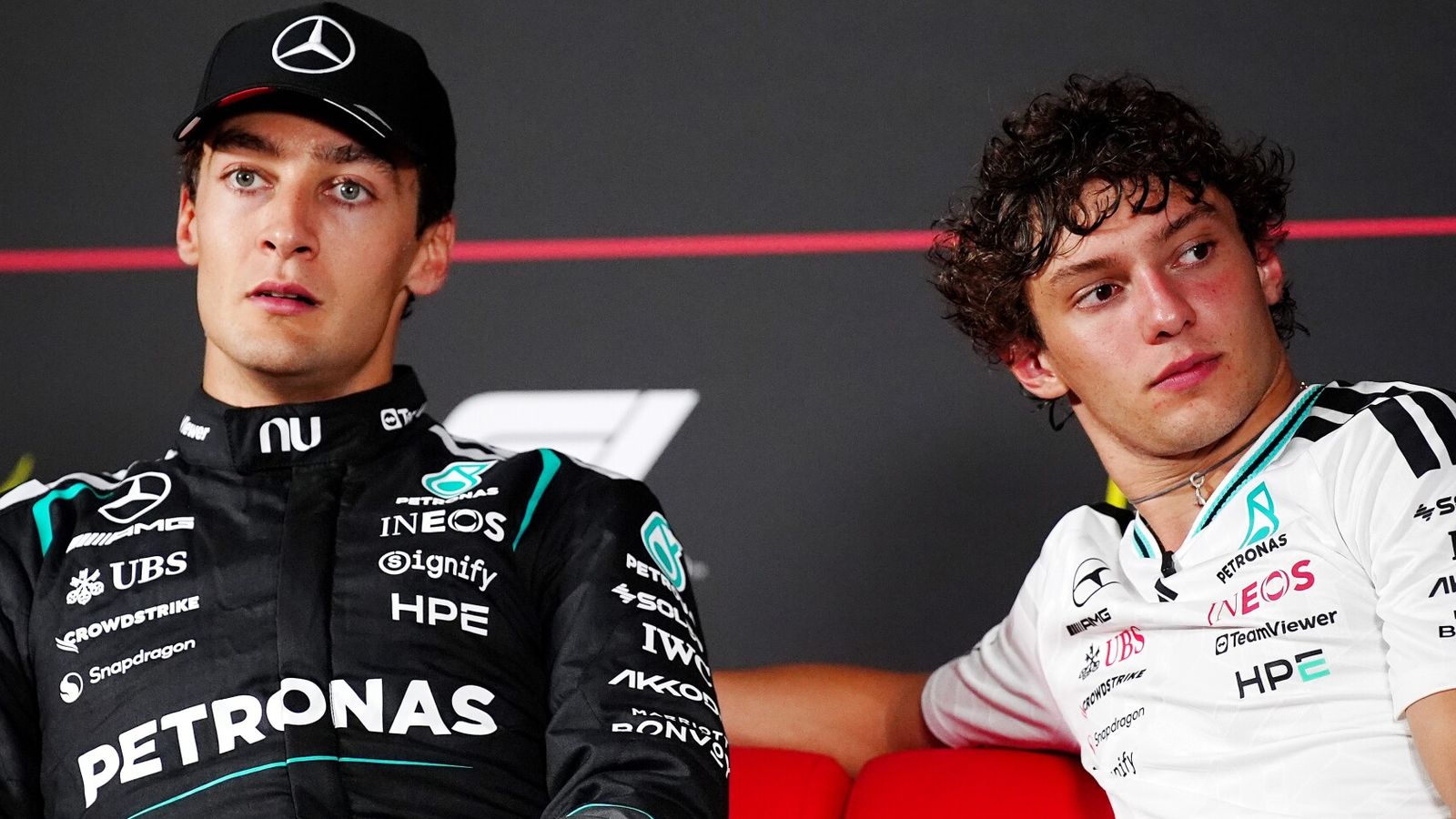
George Russell entered the 2026 Formula 1 season positioned as the presumptive focal point of Mercedes' championship campaign, only to confront an immediate statistical disruption. Kimi Antonelli, stepping into the second seat at age 19, secured five consecutive victories across the opening quarter of the calendar, establishing an unexpected operational benchmark within the Brackley garage.
Mercedes team principal Toto Wolff acknowledged the internal friction generated by that early deficit during an interview with Martin Brundle ahead of the Bahrain Grand Prix at the Sepang International Circuit. Russell, now 28, found the rookie's baseline pace difficult to process when the performance curve appeared effortless on the opposite side of the garage.
The pit-lane garage partition remains equidistant down to the millimeter, yet telemetry rarely balances itself cleanly.
"He gets down and it's difficult to cope, particularly when you have a 19-year-old coming into the team and it looks so easy," Wolff said. "Kimi is a natural that is able to capture an audience and then this is the season you have to deliver [if you are Russell]—you are the candidate for winning the championship. Suddenly things are different. Your team-mate is so competitive, which you kind of, rationally get, but it came as a surprise how competitive he was."
Telemetry Reset: From Canada Mechanical Failure to Baku Execution
Russell's campaign suffered acute mathematical degradation following a power unit failure at the Canadian Grand Prix in May. Across the subsequent stretch leading into the August summer break, he converted only two podium finishes as chemical decay and operating windows repeatedly compromised his race stints. However, a lights-to-flag victory at the Azerbaijan Grand Prix in Baku shifted the trajectory, trimming his championship deficit to Antonelli down to 66 points.
Wolff noted that Russell operated in "rocket mode" on the Baku street circuit, indicating that the driver has adapted to the psychological load of competing against a generational rookie teammate.
"I think George is in a place where that is the situation," Wolff stated. "He has a 20-year-old teammate that is one of the best rookies that has ever been. He needs to fight him to beat him. I think he has now settled into this reality of 'this is going to be really hard because he's so good'. That I think we kind of figured out together."
Operational Protocols: Managing Russell vs Antonelli
Mercedes sits on the threshold of securing its first Drivers' Championship since Lewis Hamilton took the title in 2020. Addressing the management model, Wolff contrasted the current internal environment with the contentious intra-team conflict between Hamilton and Nico Rosberg between 2013 and 2016.
Both Russell (signed at 17) and Antonelli (signed at 11) developed directly through the Mercedes junior architecture, allowing team leadership to enforce predetermined engagement protocols before sessions commence:
- Scenario Pre-Briefing: Detailed strategic contingencies mapped prior to green lights to mitigate unexpected track clashes.
- Absolute Hardware Equality: Structural refusal to distribute aerodynamic floor updates or technical revisions asymmetrically.
- Neutral Strategic Deployment: Zero commercial or political prioritization between Russell's veteran claim and Antonelli's rookie narrative.
"We've never brought an upgrade before the other guy had it over the last 10 or more years," Wolff confirmed. "They are both given the same opportunity. May the best man win. If it's George, it is a story that George Russell won his first championship. If it's Kimi, then it's a different story. It's this amazing super kid that won his first championship."