Reporting note: this article draws on Sky Sports; TaxiSports provides the summary and editorial framing.
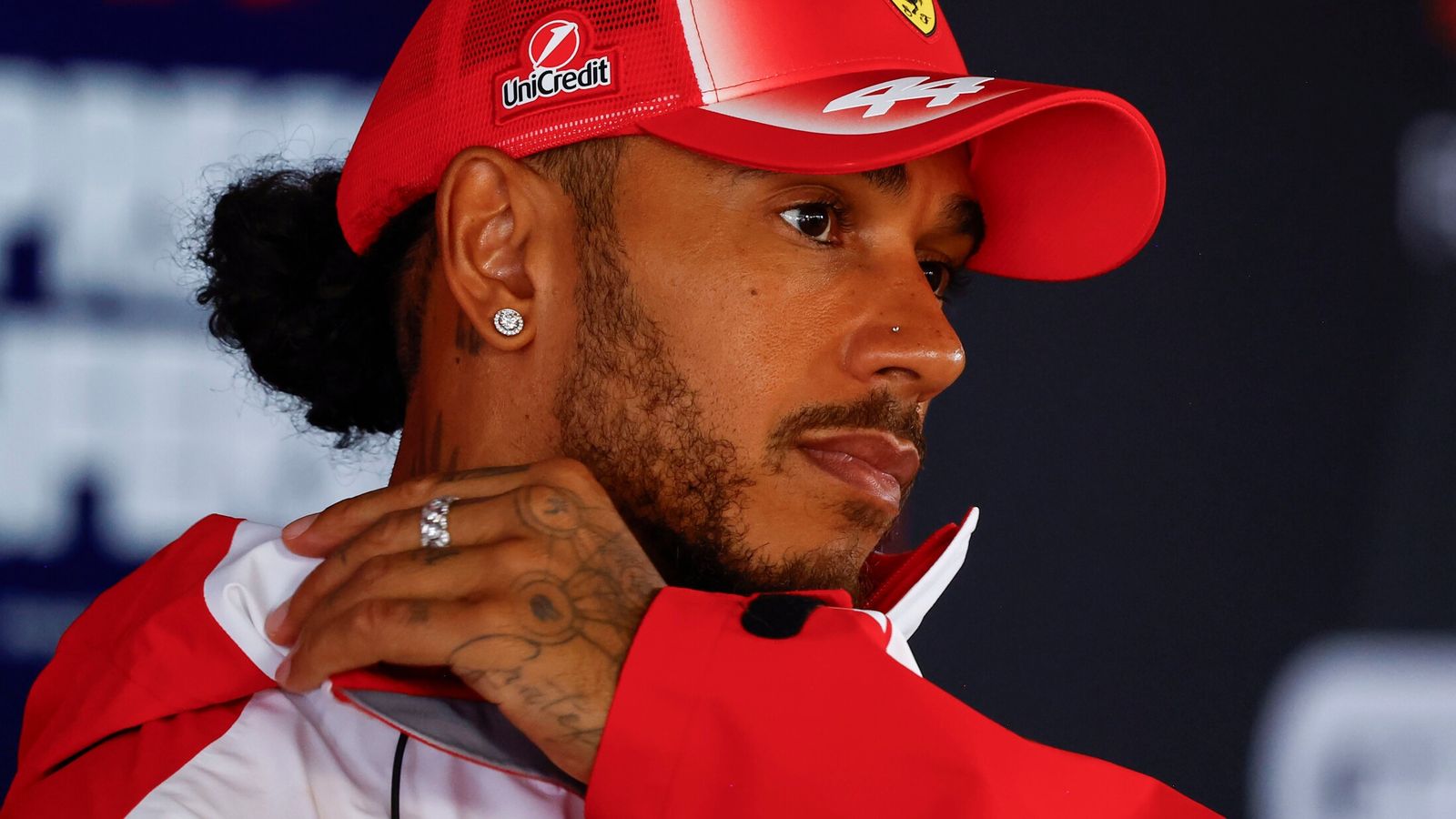
Hesitation on the Pit Wall Costs Ferrari Podium Contention
Lewis Hamilton expressed sharp frustration over Ferrari's operational hesitation during the Dutch Grand Prix, revealing he will address team order protocols privately after finishing fourth at Zandvoort. The seven-time world champion spent crucial mid-race laps bottled behind teammate Charles Leclerc on fresher rubber, ultimately leaving him unable to overhaul Mercedes' George Russell for the final podium spot.
The critical flashpoint occurred midway through the race. Emerging from a staggered pit sequence on pristine compound rubber, Hamilton caught Leclerc rapidly, carrying superior mechanical grip while the sister car struggled with severe surface degradation, the carcass graining heavily along the banked curves of the seaside circuit. When the Scuderia pit wall hesitated to swap the cars, Hamilton voiced his discontent over the team radio: "I'm quicker than Charles. These tyres are better."
As the laps ticked away and lap times bled, Hamilton’s radio messages turned curt: "We are just losing time!" After Leclerc finally pitted, Hamilton delivered a sarcastic sign-off: "A great way of wasting time guys, good job."
"I want to win. I'm here to win. It is difficult when you are looking ahead and you see the two Mercedes drivers, they get the call and it's done, and they execute straight away. They let Kimi by and let him get on with the race. I was on a different strategy and it's not the same here."
— Lewis Hamilton
Contrasting Execution: Ferrari vs. Mercedes
Hamilton pointed directly to the decisive execution of his former team, Mercedes. In the closing stages, the Brackley squad immediately instructed Russell to yield to Kimi Antonelli, who arrived from behind on fresher rubber and clear air. Antonelli swept past without delay to maximize the team's result.
In contrast, Hamilton’s delayed release behind Leclerc cost several key seconds that proved decisive in his late-race hunt of Russell. Hamilton closed down the gap in the final laps—braking deep into Turn 1, loading the front axle, balancing the tensioned floor surfaces through the sweeping mid-sector—yet ran out of laps to make a definitive move stick before the checkered flag.
Championship Standings and the Road to Monza
Despite the strategic hiccup, Hamilton noted structural progress from the SF-26 package, which received aerodynamic updates after the summer break. Ferrari’s race pace allowed them to challenge both McLaren and Mercedes after being outqualified on Saturday.
"Firstly, the guys in the garage did a fantastic job," Hamilton stated. "Pit stops, strategy was generally very, very good. The car felt awesome and they have continued to work so hard. This first half of the season we have been losing three to five tenths on the straight depending on which track we go to... but today was definitely frustrating for me. We lost several seconds behind Charles which I think ultimately would have made the difference at the end."
The fourth-place finish leaves Hamilton 59 points adrift of championship leader Antonelli in the Drivers' Championship standings. Formula 1 now heads directly to Monza for the Italian Grand Prix on September 4-6, where Ferrari will race in front of the home Tifosi.
As the paddock packed down along the North Sea coast, trackside relative humidity hovered near 78 percent against a coastal chill, contrasting sharply with the estimated two liters of fluid lost by the drivers across 72 demanding laps.

Quinn Santos
Quinn Santos covers Formula 1 with a reverent, forensic attention to the physical and acoustic life of the race. In reports, engine notes are not background noise but specific orchestral intervals moving through the grid, and every race devotes space to the degraded texture of tire compounds after a stint, read like worn material rather than performance data. Chassis geometry and floor aerodynamics are explained through architectural metaphor: load paths become load-bearing walls, floors become tensioned skins. Quinn avoids standard telemetry charts, instead reconstructing key overtakes through rhythmic, beat-heavy sentence structures that carry braking points and exits like percussion. A reader gets the feeling of the circuit as a built and sounding environment, not a sequence of lap times. Each race recap closes with an unprompted weather report comparing trackside humidity to the driver's sweat output, a small forensic reminder of how much the body and the air are part of the result.